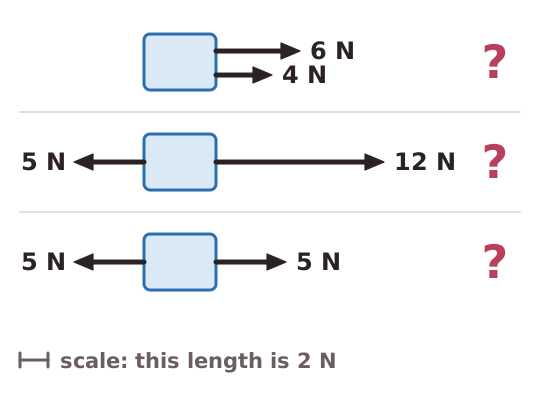
Several forces can act on one object at the same time. They can be replaced by a single force that has the same effect as all the original forces acting together. This single force is called the resultant force.
For two forces acting along a straight line, forces in the same direction are added. A 4 N push and a 6 N push in the same direction give a resultant of 10 N in that direction. Forces in opposite directions are subtracted, and the resultant acts in the direction of the larger force. A 12 N force to the right and a 5 N force to the left give a resultant of 7 N to the right.
If the forces on an object are equal and opposite, they are balanced and the resultant force is zero. The object then has the same effect as having no force on it at all.
Higher tier only: free body diagrams show all the forces acting on one isolated object as arrows, and a single force can be resolved into two components at right angles to each other.