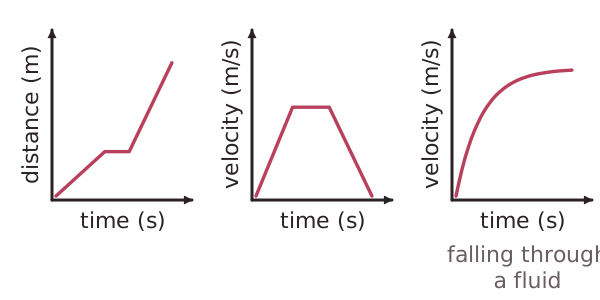
Distance is how far an object moves and has no direction, so it is a scalar quantity. Displacement is the distance in a straight line from the start point to the finish point, together with the direction of that line, so it is a vector quantity. A runner who completes one lap of a track has run 400 m, but their displacement is zero because they finish where they started. Speed is a scalar and velocity is a vector: velocity is speed in a given direction. Higher tier only: an object moving in a circle at constant speed has a changing velocity, because its direction keeps changing.
Typical speeds are walking 1.5 m/s, running 3 m/s, cycling 6 m/s, and sound in air 330 m/s. For constant speed, distance travelled = speed × time, or s = vt. For example, a car travelling 300 m in 20 s at constant speed has a speed of 15 m/s, and a cyclist riding at 6 m/s for 30 s travels 180 m. Average speed for non-uniform motion is the total distance divided by the total time. On a distance-time graph the gradient gives the speed. Higher tier only: for an accelerating object, draw a tangent and find its gradient to get the speed at that moment.
Average acceleration = change in velocity ÷ time taken, or a = Δv / t, measured in metres per second squared (m/s2). For example, a car whose velocity rises from 4 m/s to 20 m/s in 8 s has an acceleration of 2 m/s2. An object that slows down is decelerating. On a velocity-time graph the gradient gives the acceleration. Higher tier only: the area under a velocity-time graph gives the distance travelled. For uniform acceleration, v2 − u2 = 2as.
Near the Earth's surface a freely falling object has an acceleration of about 9.8 m/s2. An object falling through a fluid first accelerates because of the force of gravity. As it speeds up the resistive force grows until the resultant force is zero, and it then falls at its terminal velocity.