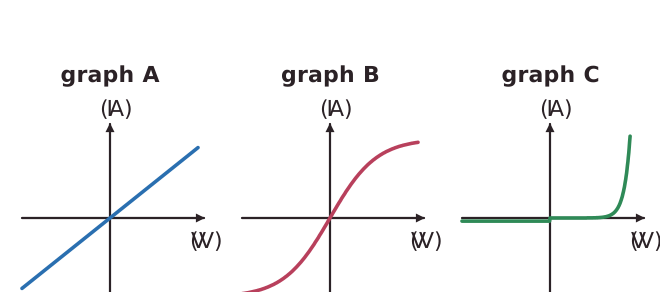
For some resistors the resistance stays constant, and for others it changes as the current changes. An ohmic conductor is a resistor at constant temperature. The current through it is directly proportional to the potential difference across it, so its I–V graph is a straight line through the origin and its resistance stays constant as the current changes.
Many components are not ohmic, so their resistance is not constant. In a filament lamp, a bigger current heats the filament. The resistance rises as the temperature rises, so the I–V graph curves and gets flatter. A diode lets current flow in one direction only. It has a very high resistance in the reverse direction, so almost no current flows that way.
A thermistor has a resistance that decreases as the temperature increases, so it is used in circuits such as a thermostat. An LDR (light-dependent resistor) has a resistance that decreases as light intensity increases, so it can switch lights on when it gets dark.
To find the resistance of a component, connect an ammeter in series with it and a voltmeter in parallel across it. Read the current and the pd, then calculate R = V / I. In required practical 16 you change the pd with a variable resistor, record the current at each setting and plot an I–V graph for a resistor, a filament lamp and a diode. A straight line shows a linear component and a curve shows a non-linear one.