The current I through a component depends on two things: the potential difference (pd) V across it and its resistance R. A greater pd pushes a bigger current through. A greater resistance makes the current smaller for the same pd. You may use either potential difference or voltage in an answer.
The three are linked by the equation potential difference = current × resistance, or V = I R. Potential difference V is in volts (V), current I in amperes (A) and resistance R in ohms (Ω). Rearranged, I = V / R and R = V / I. For example, a 12 V supply across a 4 Ω resistor gives a current of 12 / 4 = 3 A.
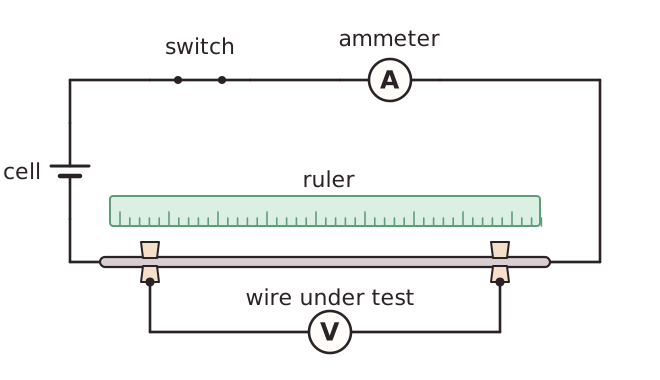
In required practical 15 you investigate what affects resistance. To test the length of a wire, you connect the wire in a circuit with an ammeter in series and a voltmeter in parallel across it. You keep the temperature constant, measure the pd and current for different lengths and calculate R = V / I each time. A longer wire has a greater resistance. You can also compare resistors in series and in parallel. Resistors in series give a larger total resistance, and resistors in parallel give a smaller total resistance than any single one.