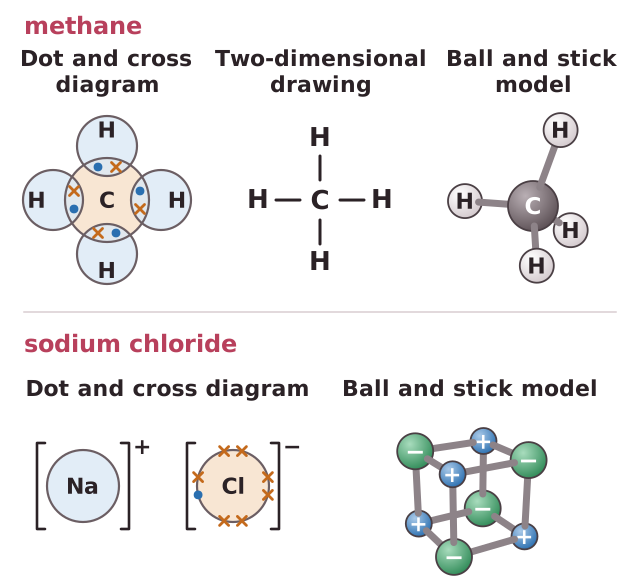
We cannot see atoms, so scientists use models to represent them. Every model is a simplification, so every model has limitations. You need to know what each model shows well and where it is misleading.
A dot and cross diagram shows only the outer shell electrons of each atom, with dots for the electrons from one atom and crosses for the electrons from the other. It is good at showing which atom each electron came from and how electrons are shared or transferred. Its limitations are that all electrons are really identical, so the dots and crosses give a false impression. The diagram is also flat, so it does not show the shape of a molecule, the relative size of the atoms or the lengths of the bonds. For an ionic compound it shows only one or two ions, not the giant lattice.
A ball and stick model uses balls for atoms and sticks for bonds. It shows the three-dimensional arrangement of the atoms and the angles between the bonds. Its limitations are that the sticks suggest a bond is a physical object, when it is really a force of attraction. It shows no electrons, and atoms are not solid balls. In an ionic lattice the sticks join only some ions, which suggests the attraction acts only between those pairs, when every ion attracts the oppositely charged ions around it in all directions.
A two-dimensional drawing on paper shows which atoms are joined but cannot show the real shape of a molecule. A three-dimensional model shows the shape but is harder to draw and does not show electrons. No single model is perfect, so we choose the one that suits the job.