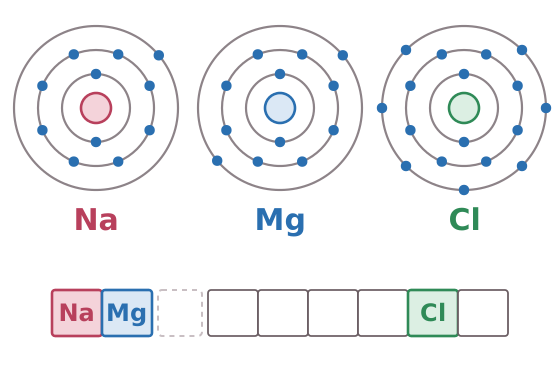
The elements are arranged in order of atomic number, which is the number of protons in the nucleus of an atom. A neutral atom has the same number of electrons as protons, so the atomic number also tells you how many electrons it has.
The electrons fill shells in order. The first shell holds up to two electrons, and the second and third shells hold up to eight each (for the first twenty elements). The arrangement is written as numbers, for example 2,8,1.
This arrangement fixes the position of the element in the table. The period number is the number of occupied shells. The group number is the number of electrons in the outer shell, for Groups 1 to 7. Sodium has atomic number 11 and arrangement 2,8,1, so it is in period 3 and Group 1. Chlorine has atomic number 17 and arrangement 2,8,7, so it is in period 3 and Group 7. Magnesium has atomic number 12 and arrangement 2,8,2, so it is in period 3 and Group 2. Elements in the same group have the same number of outer electrons, so they have similar chemical reactions.