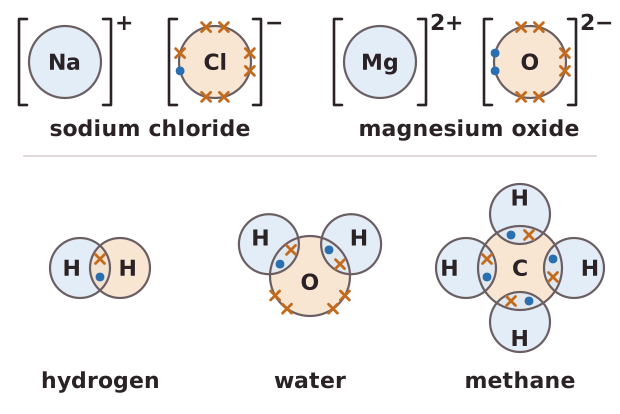
A dot and cross diagram shows only the electrons in the outer shell of each atom. The electrons from one atom are drawn as dots and the electrons from the other atom as crosses, so you can see where each electron came from.
For an ionic compound made from two elements, such as sodium chloride, the electrons are transferred. Sodium has one outer electron and chlorine has seven. The sodium electron is transferred to the chlorine atom. Each ion is drawn inside square brackets with its charge at the top right. The sodium ion has no outer electrons in the shell drawn and a positive charge. The chloride ion has eight outer electrons and a negative charge. For calcium chloride, each calcium atom transfers two electrons, one to each of two chlorine atoms.
For a simple covalent molecule the outer shells overlap, and each shared pair of electrons sits in the overlap. In water, the oxygen atom has six outer electrons and shares one pair with each of two hydrogen atoms. Oxygen then has eight outer electrons, including two non-bonding pairs, and each hydrogen has two. In methane, a carbon atom shares its four outer electrons with four hydrogen atoms, giving four shared pairs and eight outer electrons around carbon. In every case each atom ends with a full outer shell.