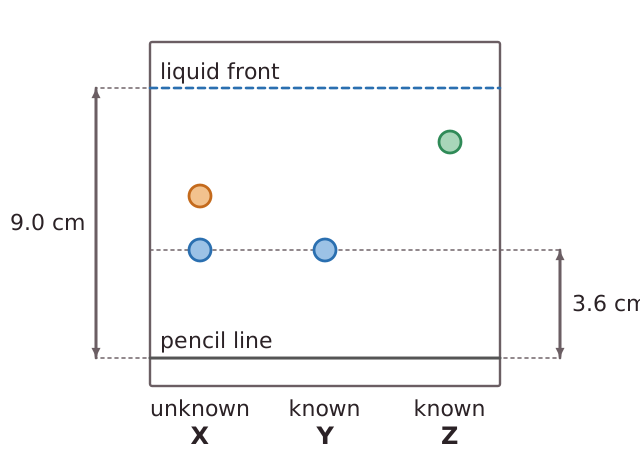
The paper after a chromatography run is called a chromatogram. Each spot on it is a separate substance. A pure substance gives one spot only. An impure substance, which is a mixture, gives two or more spots. If a sample shows a single spot in several different solvents, that is good evidence that it is pure.
To identify a substance, run it on the same paper as known substances. If one of its spots is at the same height as a known substance, and the spots match in colour, the sample may contain that substance.
You can also calculate the Rf value of a spot. Rf is the distance moved by the substance divided by the distance moved by the solvent. Both distances are measured from the baseline, and the substance distance is measured to the centre of the spot. Because it is a ratio, Rf has no units and is always between 0 and 1. For example, a spot that moves exactly half as far as the solvent front has an Rf value of 0.5. Rf values can be rounded to two significant figures. A given substance has the same Rf value in the same solvent, so Rf values can be compared with a data table.