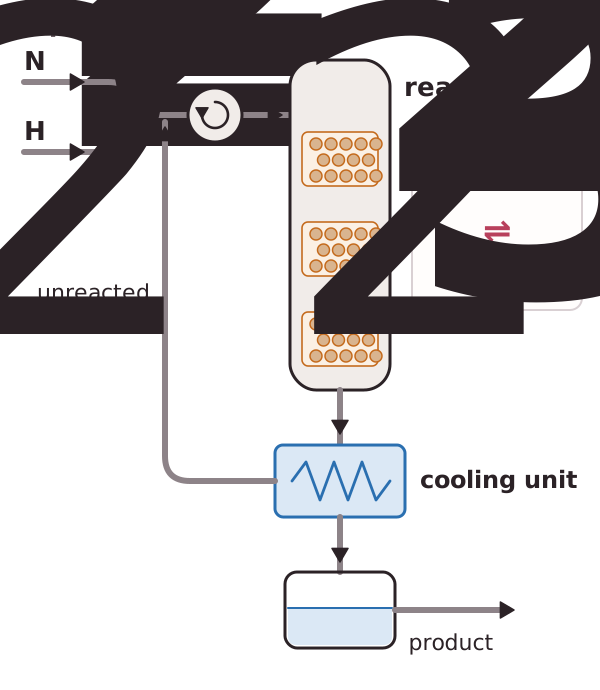
The Haber process is used to manufacture ammonia, NH3. Ammonia is used to make nitrogen-based fertilisers. The raw materials are nitrogen and hydrogen. The nitrogen comes from the air, which is about 78% nitrogen. The hydrogen is made from natural gas, which is mainly methane.
The purified gases are passed over a catalyst of iron at a high temperature of about 450 °C and a high pressure of about 200 atmospheres. Some of the nitrogen and hydrogen reacts to form ammonia. The reaction is reversible, so some of the ammonia breaks down again into nitrogen and hydrogen: nitrogen + hydrogen ⇌ ammonia, or N2 + 3H2 ⇌ 2NH3.
The mixture leaving the reactor is cooled. The ammonia turns into a liquid and is removed. Nitrogen and hydrogen do not liquefy at this temperature, so the remaining gases are recycled, which means they are returned to the reactor to react again.
Higher tier students also explain the conditions. A higher pressure moves the equilibrium towards ammonia, because there are fewer gas molecules on the right, and it also speeds up the reaction. But very high pressures need expensive equipment and a lot of energy. A lower temperature gives a greater percentage of ammonia, but the rate is too slow. About 450 °C and 200 atmospheres is a compromise between rate, yield and cost.