Most glass is soda-lime glass, made by heating a mixture of sand, sodium carbonate and limestone. Borosilicate glass is made from sand and boron trioxide and melts at a higher temperature than soda-lime glass. Clay ceramics such as pottery and bricks are made by shaping wet clay and then heating it in a furnace.
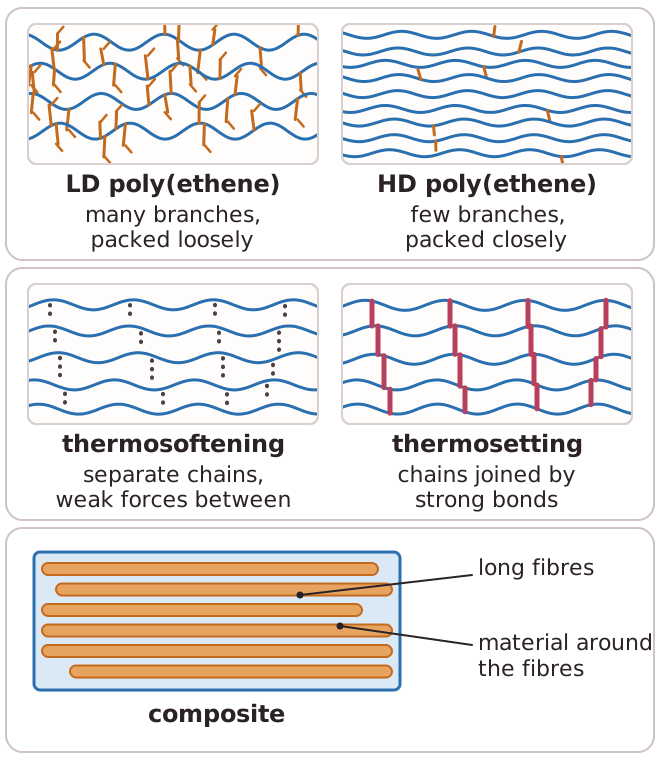
The properties of a polymer depend on the monomers it is made from and the conditions it is made under. Low density (LD) and high density (HD) poly(ethene) are both made from ethene, but under different conditions. In LD poly(ethene) the chains have many branches, so they pack loosely. In HD poly(ethene) the chains have few branches, so they pack more closely.
Thermosoftening polymers melt when heated. Their chains are separate and held together only by weak forces, so the chains can move apart. Thermosetting polymers do not melt when heated, because their chains are joined together by strong cross-links.
A composite is made of two materials. A matrix, or binder, surrounds and binds together fibres or fragments of the other material, which is called the reinforcement. Examples are fibreglass, which is glass fibres in a plastic matrix, and reinforced concrete. Given data, materials can be compared by their numbers, such as strength and density, to choose the best one for a use.