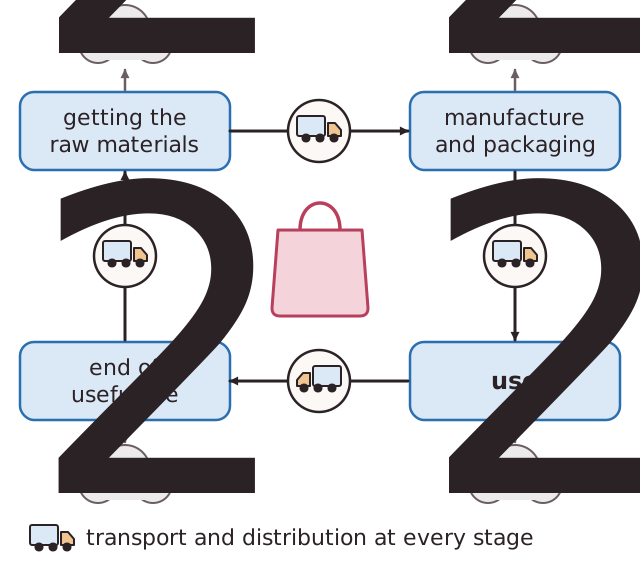
A life cycle assessment (LCA) is used to judge the effect a product has on the environment. It looks at every stage of the product's life: extracting and processing the raw materials, manufacturing and packaging, use during its lifetime, and disposal at the end of its useful life. Transport and distribution are counted at every stage.
Some things are fairly easy to measure at each stage, such as the water used, the resources used, the energy used and the amount of some wastes made. These can be given numbers and added up, so 8 MJ to make a bag plus 2 MJ to transport it gives a total of 10 MJ. The effect of a pollutant is harder, because giving it a number means making a value judgement. This is why an LCA is not a purely objective process.
A selective or abbreviated LCA looks at only some stages or some impacts. These can be misused to reach a conclusion that was decided in advance, for example to support a claim in an advert.
A simple comparative LCA can be done for shopping bags. A plastic bag is made from crude oil, a limited resource, while a paper bag needs more energy and water to make. The plastic bag can be reused many times but lasts a long time as waste. A paper bag is often used once and breaks down faster. Which bag is better depends on which stages and impacts you choose to compare.