The rate of a reaction tells us how fast reactants are used up or how fast products are made. We find it by measuring the quantity of a reactant used, or the quantity of a product formed, over a period of time. The quantity can be a mass in grams or a volume in cm3.
The mean rate of reaction is the quantity of reactant used divided by the time taken, or the quantity of product formed divided by the time taken. The units are g/s when the quantity is a mass, and cm3/s when it is a volume. For example, if 12 g of a reactant is used up in 3 s, the mean rate is 12 ÷ 3 = 4 g/s. Higher tier students can also measure the quantity in moles, which gives a rate in mol/s.
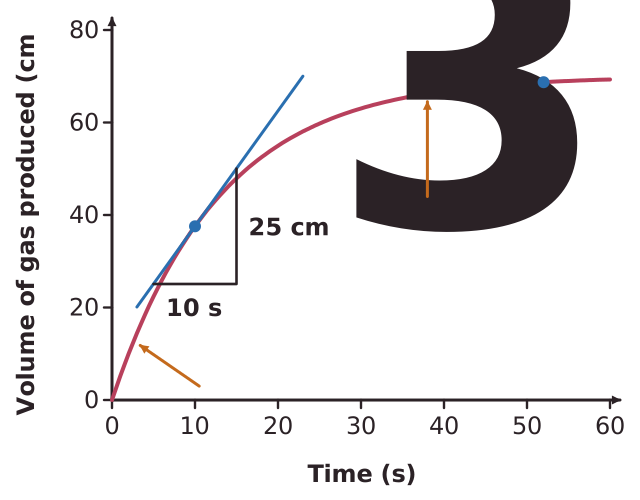
Results are often plotted as a graph of quantity of product formed (or reactant used) against time. The line is steepest at the start, when the reactants are at their highest concentration and the rate is greatest. The line then gets less steep and becomes flat when the reaction has stopped because one reactant has been used up.
The rate at one particular moment is found by drawing a tangent to the curve at that time. The slope of the tangent measures the rate, and a steeper tangent means a higher rate. Higher tier students must calculate the gradient of the tangent, which is the change up the vertical axis divided by the change along the horizontal axis.