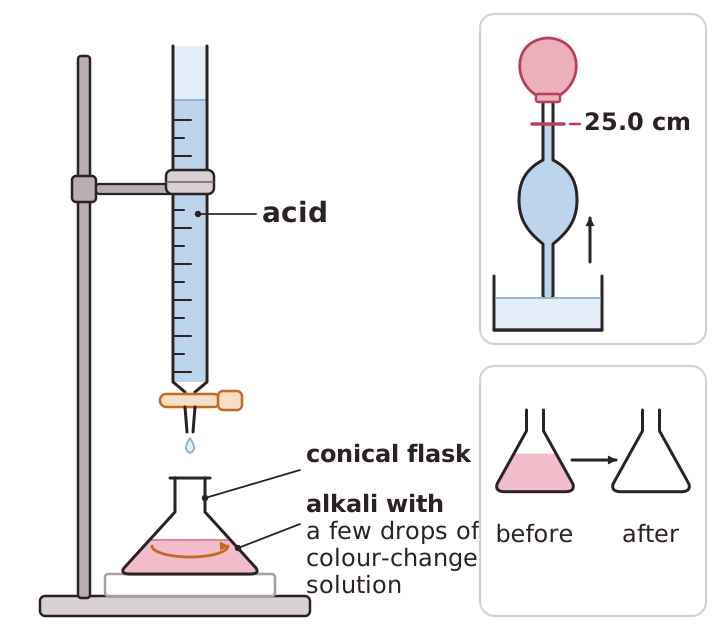
A titration measures the volumes of an acid solution and an alkali solution that react exactly with each other. It uses a suitable indicator, such as phenolphthalein or methyl orange, which changes colour sharply. Universal indicator is not suitable because its colour changes gradually.
Required practical 2 uses a strong acid and a strong alkali, such as hydrochloric acid and sodium hydroxide:
- Use a pipette to put 25.0 cm3 of alkali into a conical flask, and add a few drops of indicator. Stand the flask on a white tile.
- Fill a burette with the acid and read the initial volume.
- Add the acid slowly, swirling the flask. Near the end point add it drop by drop.
- The end point is when the indicator just changes colour. Read the final volume. The titre is the final reading minus the initial reading.
- Do a rough titration first, then repeat until you have results that are concordant, which means within 0.10 cm3 of each other. Use the mean of the concordant results.
For example, titres of 22.40, 22.30 and 22.35 cm3 are concordant. Their mean is 22.35 cm3.
Higher tier only: the results can be used to find a concentration. Suppose 25.0 cm3 of sodium hydroxide solution is neutralised by 20.0 cm3 of hydrochloric acid of concentration 0.100 mol/dm3. Moles of acid = 0.100 × 20.0 ÷ 1000 = 0.00200 mol. The equation shows 1 mol of acid reacts with 1 mol of alkali, so there is 0.00200 mol of alkali in 0.0250 dm3. The concentration is 0.00200 ÷ 0.0250 = 0.0800 mol/dm3. To change to g/dm3, multiply by the relative formula mass: 0.0800 × 40 = 3.20 g/dm3.