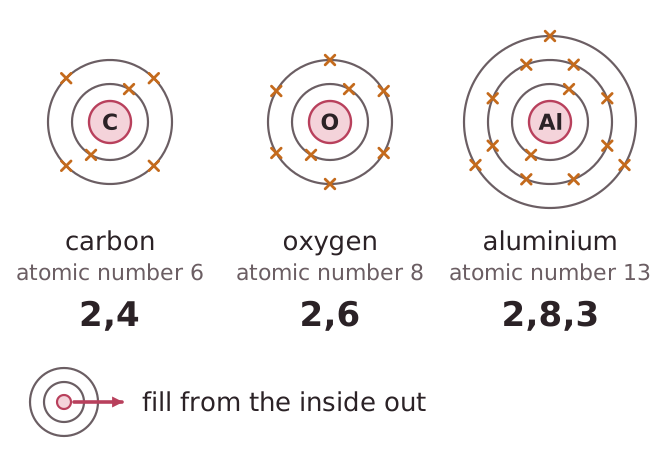
The electrons in an atom are arranged in energy levels, also called shells. Electrons always occupy the lowest available energy level first, which means the innermost available shell. A shell must be full before electrons start to fill the next one.
The first shell holds a maximum of 2 electrons. The second shell holds a maximum of 8 electrons, and the third shell also holds 8 electrons when we are working with the first twenty elements. The number of electrons in a neutral atom is the same as its atomic number, so this is the number we share out between the shells.
The electronic structure can be written as numbers, with commas between the shells. Sodium has atomic number 11, so it has 11 electrons. Two go in the first shell, eight in the second and the last one in the third shell. Its electronic structure is 2,8,1. Chlorine has 17 electrons, so its electronic structure is 2,8,7. A fourth shell is only started once the third shell has 8 electrons.
The same structure can be drawn as a diagram, with a nucleus in the centre and a circle for each shell. Each electron is shown as a dot or cross on a circle. The numbers and the diagram carry exactly the same information.