 BRAINCAKE
Bond Polarity
In a non-polar bond, the bonded electron pair is shared equally between the two bonded atoms because either the atoms have the same or similar electronegativities or the atoms are the same.
for instance in O2 or Cl2. In these cases the bond is a pure covalent bond.
Polar bonds are formed between atoms with different electronegativities.
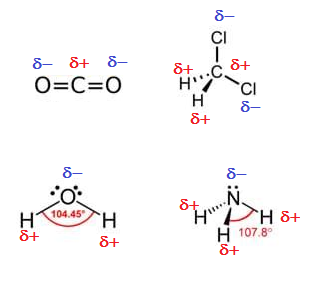
Sign in free to see the rest of this lesson, the R.E.C.I.P.E. recall steps and the quiz
BrainCake is free. Make an account in seconds and pick up where this page stops.
Key terms in this lesson
- Covalent bond
- A strong electrostatic attraction between a shared pair of electrons and the nuclei of the bonded atoms.
More in Shapes and Intermolecular Forces
- BF3 and SF6 and PCl5
- Polyatomic ions.
- More examples.
- Electronegativity
- Polar Solvents and Solubility
- Induced Dipole-Dipole Interactions (London Forces)
- Permanent dipole-dipole interactions
- Solubility of Simple Molecules
All 13 lessons in Shapes and Intermolecular Forces · All OCR AS-level Chemistry topics