A more reactive halogen will displace a less reactive halide from a solution of its salt. The solution changes colour
Solutions of bromine and iodine in water can appear similar in colour as they are both brown. A non-polar reagent such as cyclohexane can be added. Halogens dissolve more readily in cyclohexane than water and the colours are easier to tell apart. Chlorine is pale green in cyclohexane, bromine is orange and iodine is violet.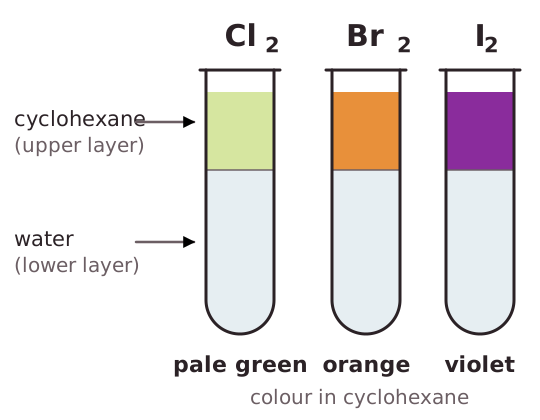 The three reactions are:
Cl2(aq) + 2Br-(aq) → 2Cl-(aq) + Br2(aq)pale green to orangeCl2(aq) + 2I-(aq) → 2Cl-(aq) + I2(aq)pale green to brownBr2(aq) + 2I-(aq) → 2Br-(aq) + I2(aq)orange to brownThe reaction is a redox reaction. The more reactive halogen is reduced and the less reactive halide is oxidised. The ionic half equations are:
Cl2(aq) + 2e- → 2Cl-
2Br-(aq) → Br2 + 2e-
Solutions of bromine and iodine in water can appear similar in colour as they are both brown. A non-polar reagent such as cyclohexane can be added. Halogens dissolve more readily in cyclohexane than water and the colours are easier to tell apart. Chlorine is pale green in cyclohexane, bromine is orange and iodine is violet.
The three reactions are:Cl2(aq) + 2Br-(aq) → 2Cl-(aq) + Br2(aq)pale green to orangeCl2(aq) + 2I-(aq) → 2Cl-(aq) + I2(aq)pale green to brownBr2(aq) + 2I-(aq) → 2Br-(aq) + I2(aq)orange to brownThe reaction is a redox reaction. The more reactive halogen is reduced and the less reactive halide is oxidised. The ionic half equations are:
Cl2(aq) + 2e- → 2Cl-
2Br-(aq) → Br2 + 2e-