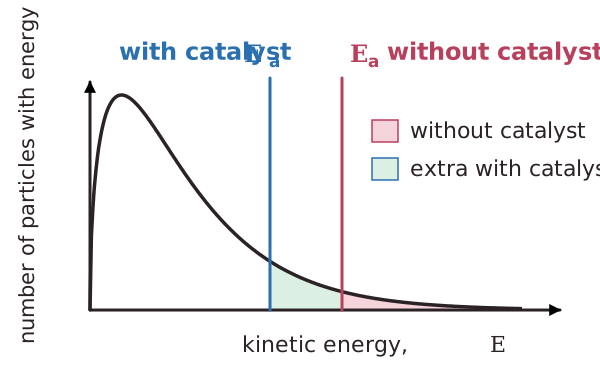
A catalyst provides an alternative reaction pathway with a lower activation energy. It does not change the shape of the Boltzmann distribution, because the temperature and the energies of the particles stay the same.On the Boltzmann distribution curve, the activation energy line moves to the left when a catalyst is used.The area under the curve to the right of the new, lower activation energy is larger. This means a greater proportion of particles have energy greater than or equal to the activation energy.More collisions are successful in a given time, so the rate of reaction increases. The catalyst itself is not used up and can be reused.
The Boltzmann Distribution Curve and Catalysts
Read the text
Read the text and highlight anything you think is important. When you go on, the text is hidden and you answer from memory.
Specification: OCR Chemistry A (H032), AS-level, 3.2.2 Reaction rates. Topic: Reaction Rates.
Key terms in this lesson
- Activation energy
- The minimum energy required for a reaction to take place.
- Catalyst
- A substance that increases the rate of a chemical reaction without being used up, by providing an alternative reaction pathway with a lower activation energy.
More in Reaction Rates
- Factors affecting the Rate of a Chemical Reaction
- Following the Progress of a Reaction
- Catalysts
- Homogenous Catalysts
- Heterogenous Catalysts
- Catalysts and Sustainability
- Autocatalysis
- The Boltzmann Distribution Curve and Temperature
All 10 lessons in Reaction Rates · All OCR AS-level Chemistry topics