A chemical reaction undergoes autocatalysis if a product of the reaction acts as a catalyst for the reaction. The reaction starts slowly, then speeds up as the product is formed.In the reaction:2MnO4- + 16H+ + 5C2O42- → 2Mn2+ + 8H2O + 10CO2The Mn2+ reduces the MnO4- to Mn3+The Mn3+ then oxidises the C2O4 to CO2 reforming Mn2+.
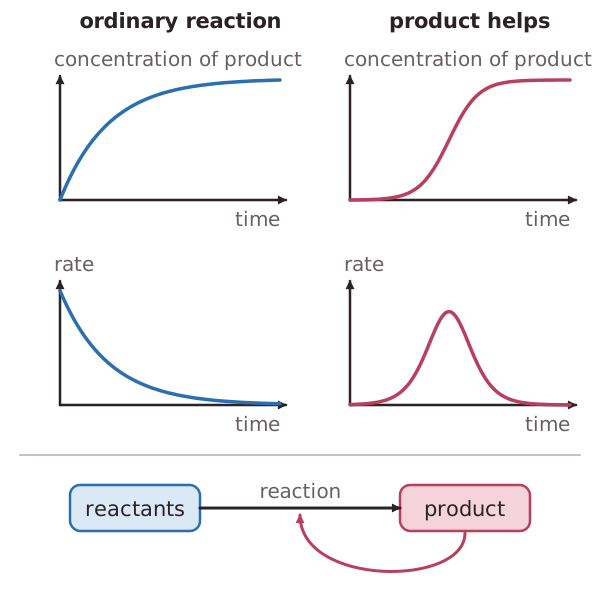
Autocatalysis
Read the text
Read the text and highlight anything you think is important. When you go on, the text is hidden and you answer from memory.
Specification: OCR Chemistry A (H032), AS-level, 3.2.2 Reaction rates. Topic: Reaction Rates.
Key terms in this lesson
- Catalyst
- A substance that increases the rate of a chemical reaction without being used up, by providing an alternative reaction pathway with a lower activation energy.
More in Reaction Rates
- Factors affecting the Rate of a Chemical Reaction
- Following the Progress of a Reaction
- Catalysts
- Homogenous Catalysts
- Heterogenous Catalysts
- Catalysts and Sustainability
- The Boltzmann Distribution Curve and Temperature
- The Boltzmann Distribution Curve and Catalysts
All 10 lessons in Reaction Rates · All OCR AS-level Chemistry topics