A homogenous catalyst has the same physical state as the reactants. The catalyst reacts with the reactants to form an intermediate. The intermediate then breaks down to give the product regenerating the catalyst.
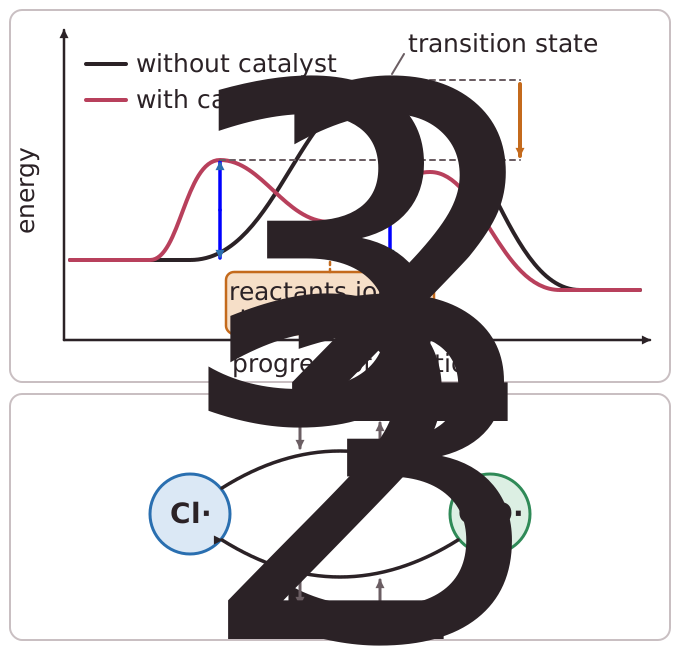
For example, ethanol and ethanoic acid react to form the ester ethyl ethanoate. Concentrated sulfuric acid acts as the catalyst.CH3COOH (l) + C2H5OH (l) ⇌ CH3COOC2H5(l) + H2O(l)
Homogenous Catalysts
Read the text
Read the text and highlight anything you think is important. When you go on, the text is hidden and you answer from memory.
Specification: OCR Chemistry A (H032), AS-level, 3.2.2 Reaction rates. Topic: Reaction Rates.
Key terms in this lesson
- Acid
- A proton donor; a substance that releases hydrogen ions when dissolved in water.
- Catalyst
- A substance that increases the rate of a chemical reaction without being used up, by providing an alternative reaction pathway with a lower activation energy.
More in Reaction Rates
- The Rate of Reaction
- Factors affecting the Rate of a Chemical Reaction
- Following the Progress of a Reaction
- Catalysts
- Heterogenous Catalysts
- Catalysts and Sustainability
- Autocatalysis
- The Boltzmann Distribution Curve and Temperature
All 10 lessons in Reaction Rates · All OCR AS-level Chemistry topics