When a halogenoalkane is warmed with aqueous sodium hydroxide or potassium hydroxide, a nucleophilic substitution reaction produces an alcohol.CH3CH2CH2CH2Br + OH− → CH3CH2CH2CH2OH + Br− 1-bromobutane forms butan-1-ol. The hydroxide ion acts as a nucleophile, using a lone pair to attack the δ+ carbon.Conditions: NaOH(aq) or KOH(aq), heated under reflux. Refluxing lets the mixture be heated for a long time without the volatile organic compounds escaping: vapours condense in the vertical condenser and drip back into the flask. A little ethanol may be added so the halogenoalkane mixes with the aqueous alkali.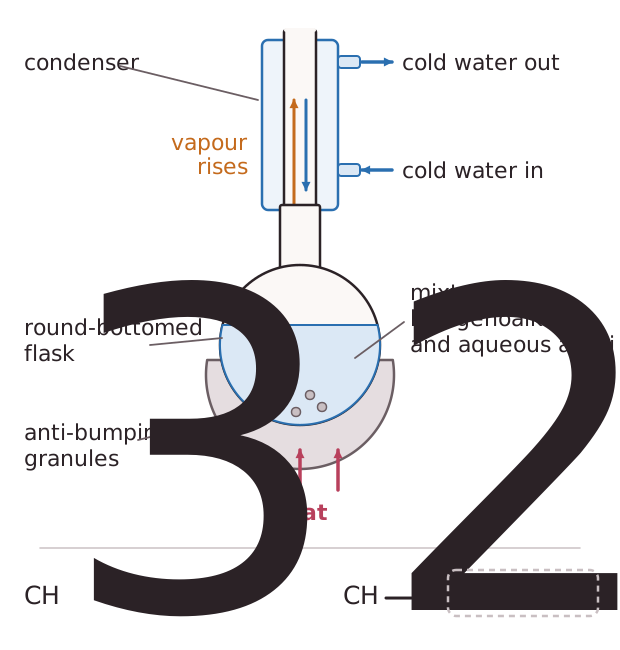 The reaction is much faster than hydrolysis by water alone, because OH− is negatively charged and is a much stronger nucleophile than H2O.More examples: 2-chloropropane gives propan-2-ol; 2-bromo-2-methylpropane gives 2-methylpropan-2-ol.Identifying the halogen: after the reaction, the halide ion is in the solution. To test it:
1. Add dilute nitric acid to neutralise the excess OH−. Otherwise the hydroxide ions would react with silver ions to form a brown precipitate of silver oxide.
2. Add silver nitrate solution and observe the colour of the precipitate (white AgCl, cream AgBr, yellow AgI).Nitric acid is used rather than hydrochloric acid, because hydrochloric acid would add chloride ions and give a white precipitate whatever the halogen.
The reaction is much faster than hydrolysis by water alone, because OH− is negatively charged and is a much stronger nucleophile than H2O.More examples: 2-chloropropane gives propan-2-ol; 2-bromo-2-methylpropane gives 2-methylpropan-2-ol.Identifying the halogen: after the reaction, the halide ion is in the solution. To test it:1. Add dilute nitric acid to neutralise the excess OH−. Otherwise the hydroxide ions would react with silver ions to form a brown precipitate of silver oxide.
2. Add silver nitrate solution and observe the colour of the precipitate (white AgCl, cream AgBr, yellow AgI).Nitric acid is used rather than hydrochloric acid, because hydrochloric acid would add chloride ions and give a white precipitate whatever the halogen.