 BRAINCAKE
Nucleophilic Substitution
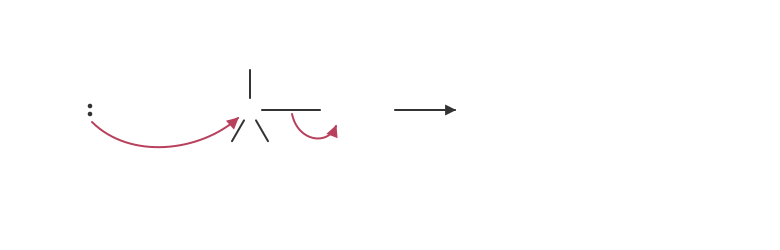
In nucleophilic substitution, a nucleophile attacks a halogenoalkane and replaces the halogen atom. The halogen leaves as a halide ion (the leaving group).
R-X + Nu− → R-Nu + X−
Common nucleophiles are OH−, CN−, NH3 and H2O. Each has a lone pair of electrons.
Sign in free to see the rest of this lesson, the R.E.C.I.P.E. recall steps and the quiz
BrainCake is free. Make an account in seconds and pick up where this page stops.
Key terms in this lesson
- nucleophile
- A species with a lone pair of electrons that is attracted to a positive centre and donates the pair to form a new covalent bond.
- curly arrow
- A symbol in a reaction mechanism showing the movement of a pair of electrons, from a bond or lone pair to where they end up.
More in Halogenoalkanes
- Classifying Halogenoalkanes
- Reactivity of Halogenoalkanes
- Hydrolysis Reactions
- Comparing the Rates of Hydrolysis
- Reaction with Alkali
- Reaction with Aqueous Alkali
- Reaction with Ammonia
- Reaction with KCN
All 11 lessons in Halogenoalkanes · All Edexcel AS-level Chemistry topics