Halogenoalkanes are classified by how many carbon atoms are bonded to the carbon that carries the halogen.• Primary (1°): the C-X carbon is bonded to one other carbon atom (or none). Examples: bromoethane, CH3CH2Br, and 1-bromobutane. Halogenomethanes such as bromomethane, CH3Br, are also counted as primary.
• Secondary (2°): the C-X carbon is bonded to two other carbon atoms. Example: 2-bromopropane, CH3CHBrCH3.
• Tertiary (3°): the C-X carbon is bonded to three other carbon atoms. Example: 2-chloro-2-methylpropane, (CH3)3CCl.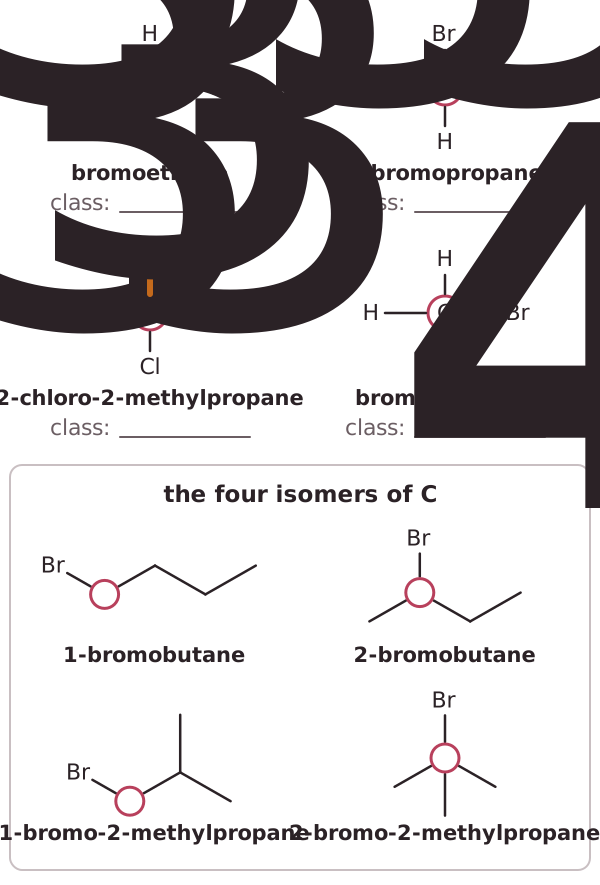 A quick check: a primary halogenoalkane has the group -CH2X (or CH3X), a secondary has -CHX-, and a tertiary has a C-X carbon with no hydrogen atoms on it.Worked example: the four structural isomers of C4H9Br are
• 1-bromobutane, CH3CH2CH2CH2Br: primary
• 2-bromobutane, CH3CHBrCH2CH3: secondary
• 1-bromo-2-methylpropane, (CH3)2CHCH2Br: primary (the chain is branched, but the C-Br carbon is bonded to only one carbon)
• 2-bromo-2-methylpropane, (CH3)3CBr: tertiarySo only one of the four isomers is tertiary.The classification matters because primary, secondary and tertiary halogenoalkanes react at different rates, and tertiary halogenoalkanes are hydrolysed fastest.
• Secondary (2°): the C-X carbon is bonded to two other carbon atoms. Example: 2-bromopropane, CH3CHBrCH3.
• Tertiary (3°): the C-X carbon is bonded to three other carbon atoms. Example: 2-chloro-2-methylpropane, (CH3)3CCl.
A quick check: a primary halogenoalkane has the group -CH2X (or CH3X), a secondary has -CHX-, and a tertiary has a C-X carbon with no hydrogen atoms on it.Worked example: the four structural isomers of C4H9Br are• 1-bromobutane, CH3CH2CH2CH2Br: primary
• 2-bromobutane, CH3CHBrCH2CH3: secondary
• 1-bromo-2-methylpropane, (CH3)2CHCH2Br: primary (the chain is branched, but the C-Br carbon is bonded to only one carbon)
• 2-bromo-2-methylpropane, (CH3)3CBr: tertiarySo only one of the four isomers is tertiary.The classification matters because primary, secondary and tertiary halogenoalkanes react at different rates, and tertiary halogenoalkanes are hydrolysed fastest.