 BRAINCAKE
Successive Ionisation Energies
The first ionisation energy is the least endothermic as energy is needed to remove an electron from a neutral atom. In a +1 ion, the proton:electron ratio is increased. The same number of protons are attracting fewer electrons and the effective nuclear charge is increased.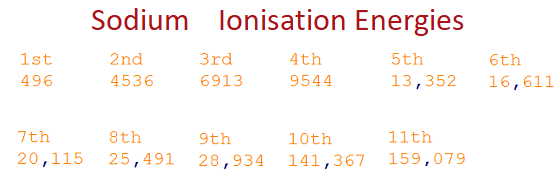
The second ionisation energy is therefore more endothermic than the first as more energy is needed to remove an electron from a +1 ion. The third electron needs even more energy than the second, and so on.
A large jump in successive ionisation energies occurs when an electron is being removed from a shell closer to the nucleus. For example,
Sign in free to see the rest of this lesson, the R.E.C.I.P.E. recall steps and the quiz
BrainCake is free. Make an account in seconds and pick up where this page stops.
Key terms in this lesson
- ionisation energy
- The energy needed to remove one electron from each atom in one mole of gaseous atoms, forming one mole of gaseous 1+ ions.
More in Atomic Structure
- Orbitals
- Electronic Configurations
- Predicting Electronic Configuration
- Energy Levels and Emission Spectra
- First Ionisation Energy
- The Energy of an Electron
- Ionisation Energy across a Period
- Ionisation Energy Down a Group
All 19 lessons in Atomic Structure · All Edexcel AS-level Chemistry topics