Pauli Exclusion Principle and Hund's RuleThe Pauli exclusion principle states that two electrons may occupy the same orbital only if they have opposite spins.Hund's rule states that electrons occupy orbitals of the same energy singly before pairing.The 4s orbital has a lower energy than the 3d orbitals, so the 4s orbital is filled before the 3d orbitals.The lowest energy orbitals are filled first.Each orbital can accommodate two electrons.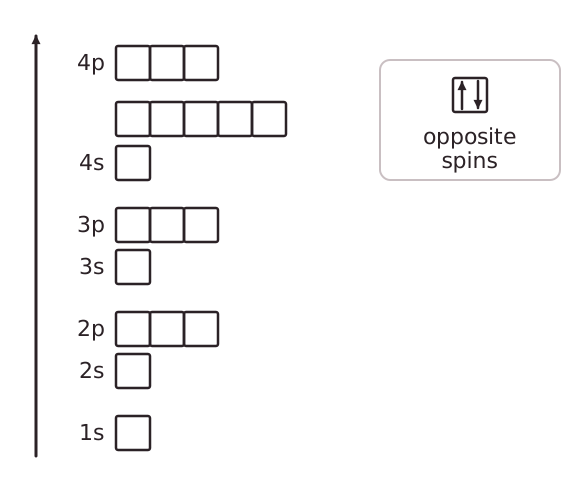 The exact energy of the electron is determined by the number of protons and the repulsion of the inner shell electrons so there are exceptions to the general rule.potassium1s2 2s2 2p6 3s2 3p64s1chromium1s2 2s2 2p6 3s2 3p6 4s1 3d5copper1s2 2s2 2p6 3s2 3p6 4s1 3d10