A biofuel is a fuel made from biomass: plant or animal material from recently living organisms. Because new crops can be grown each year, biofuels are renewable.BioethanolCrops such as sugar cane, sugar beet and maize are used as a source of sugars. The sugars are converted to ethanol by fermentation:
C6H12O6 → 2C2H5OH + 2CO2
Conditions: yeast (which provides the enzymes), about 30-40 °C, and no air (anaerobic), so the ethanol is not oxidised. Fermentation stops at about 15% ethanol, so the ethanol is separated by fractional distillation. It is blended with petrol, for example as E10 (10% ethanol).BiodieselVegetable oils (such as rapeseed oil) or used cooking oil are reacted with methanol, using a catalyst, to make esters that can be used in diesel engines.BiogasAnimal waste, sewage and food waste are broken down by bacteria in the absence of air (anaerobic digestion). The gas produced is mainly methane, which can be burned for heating or electricity.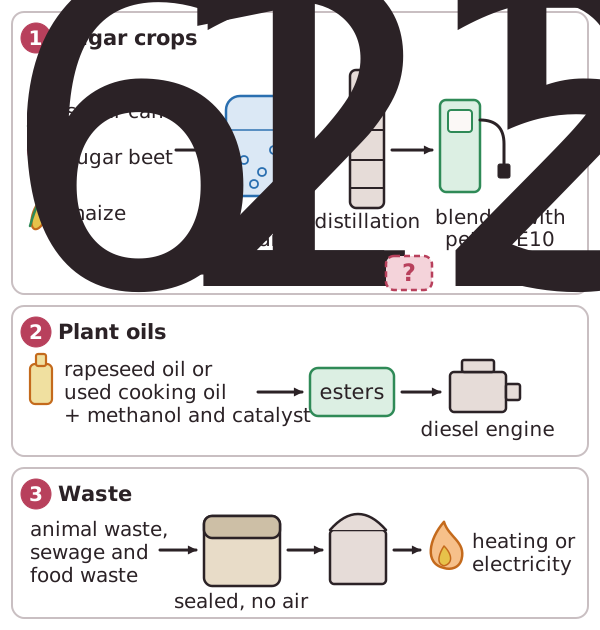 Worked example: what mass of ethanol can be made from 180 g of glucose? Mr glucose = 180, so this is 1.00 mol. The equation gives 2 mol of ethanol, Mr 46, so the mass is 2 × 46 = 92 g.Biofuels burn in the same way as other fuels: ethanol burns completely to carbon dioxide and water.
Conditions: yeast (which provides the enzymes), about 30-40 °C, and no air (anaerobic), so the ethanol is not oxidised. Fermentation stops at about 15% ethanol, so the ethanol is separated by fractional distillation. It is blended with petrol, for example as E10 (10% ethanol).BiodieselVegetable oils (such as rapeseed oil) or used cooking oil are reacted with methanol, using a catalyst, to make esters that can be used in diesel engines.BiogasAnimal waste, sewage and food waste are broken down by bacteria in the absence of air (anaerobic digestion). The gas produced is mainly methane, which can be burned for heating or electricity.
Worked example: what mass of ethanol can be made from 180 g of glucose? Mr glucose = 180, so this is 1.00 mol. The equation gives 2 mol of ethanol, Mr 46, so the mass is 2 × 46 = 92 g.Biofuels burn in the same way as other fuels: ethanol burns completely to carbon dioxide and water.