In nucleophilic substitution a nucleophile replaces the halogen atom in a halogenoalkane. The general equation is R-X + Nu- → R-Nu + X-.The mechanism is shown with curly arrows, and each curly arrow shows the movement of a pair of electrons. A curly arrow must start from a lone pair or a bond.The first curly arrow goes from the lone pair on the nucleophile to the δ+ carbon atom. The second curly arrow goes from the C-X bond to the halogen atom, showing the bond breaking.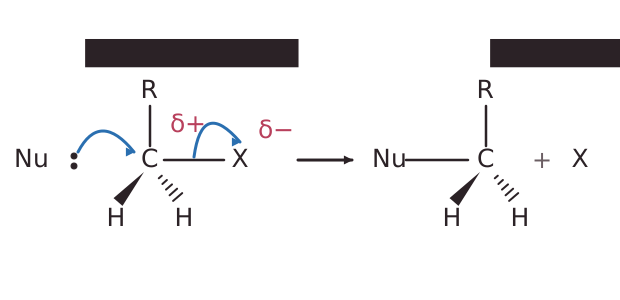 The halogen leaves as a halide ion, taking both bonding electrons with it. The new bond between the carbon and the nucleophile replaces the old C-X bond.For example, bromoethane reacts with hydroxide ions to give ethanol and a bromide ion.