Halogenoalkanes are classified as primary, secondary or tertiary. The classification depends on how many alkyl groups are attached to the carbon atom that is bonded to the halogen.In a primary halogenoalkane that carbon is attached to one other carbon atom, for example 1-bromobutane. Halomethanes such as chloromethane are also grouped as primary.In a secondary halogenoalkane the carbon is attached to two other carbon atoms, for example 2-bromobutane.In a tertiary halogenoalkane the carbon is attached to three other carbon atoms, for example 2-bromo-2-methylpropane.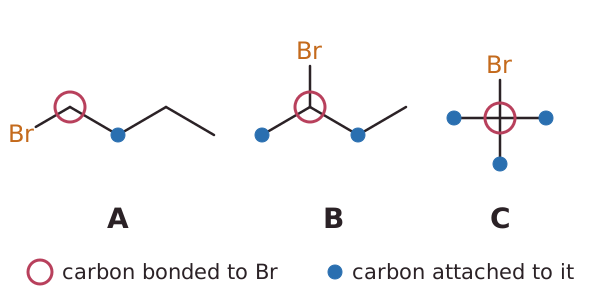 The classification helps to predict which reaction happens with hydroxide ions, since tertiary halogenoalkanes are more likely to undergo elimination.