Equilibrium can only be reached in a closed system where the reactants and products cannot escape.Equilibrium is a dynamic process but the macroscopic properties (e.g. concentrations) of the system do not change with time. Equilibrium can be approached in either direction.In the reaction:A + B ⇌ C + DInitially there is only A and B present.As the reaction proceeds, the rate of the forward reaction decreases as the reactants are used up.As more products are formed, the rate of the reverse reaction increases.Eventually, the rate of the forward reaction is equal to the rate of the reverse reaction and an equilibrium is reached
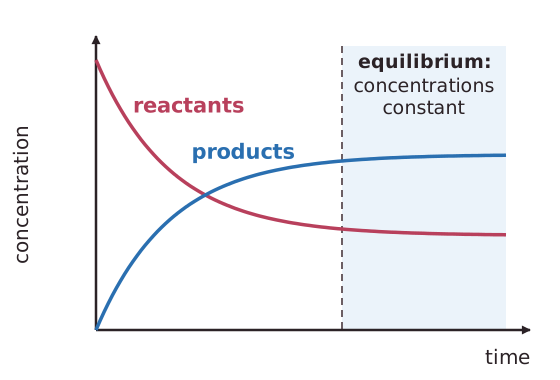
The point at which the rate of the forward reaction is equal to the reverse reaction determines the position of equilibrium. The relative proportions of products and reactants become constant.
Chemical Equilibria
Read the text
Read the text and highlight anything you think is important. When you go on, the text is hidden and you answer from memory.
Specification: AQA Chemistry (7404), AS-level, 3.1.6.1 Chemical equilibria and Le Chatelier's principle. Topic: Equilibria.
Key terms in this lesson
- Position of equilibrium
- The relative amounts of reactants and products present when a reversible reaction has reached equilibrium.
- Closed system
- A system in which reactants and products cannot escape, so none of the matter involved is lost to the surroundings.
More in Equilibria
- Dynamic Equilibrium
- Le Chatelier's Principle
- Changing Concentrations
- Changing Pressure
- Changing Temperature
- Catalysts
- Equilibrium Reactions in Industry
- Ammonia
All 20 lessons in Equilibria · All AQA AS-level Chemistry topics