The law of conservation of energy states that energy cannot be created or destroyed. Energy can therefore be transferred between the system (reactants and products) and the surroundings (apparatus and the environment).The enthalpy of a system cannot be directly measured, but the enthalpy changes can be measured experimentally. Enthalpy profile diagrams represent the relative enthalpies of reactants and products and the enthalpy change ΔH.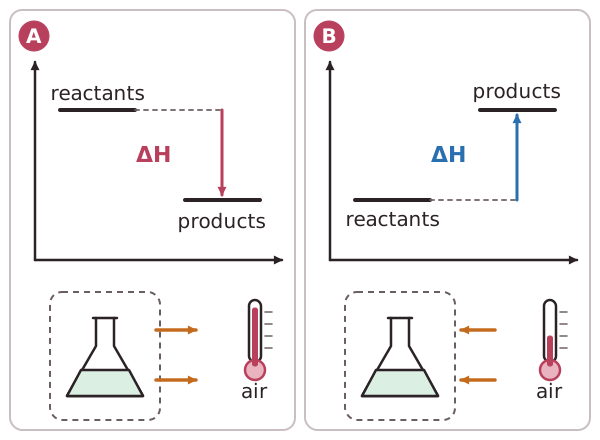 In an exothermic reaction, energy is transferred from the system to the surroundings. ΔH is negative because Hproducts is less than Hreactants and the temperature of the surroundings increases.In an endothermic reaction, energy is transferred from the surroundings to the system. ΔH is positive because Hproducts is greater than Hreactants and the temperature of the surroundings decreases.