There are different types of mass spectrometer. The time-of-flight mass spectrometer works on the principle that ions can be separated by mass and charge.The sample is placed in the mass spectrometer and vaporisedThe vaporised sample is ionised to form positive ions.The ions are accelerated by an electric field. 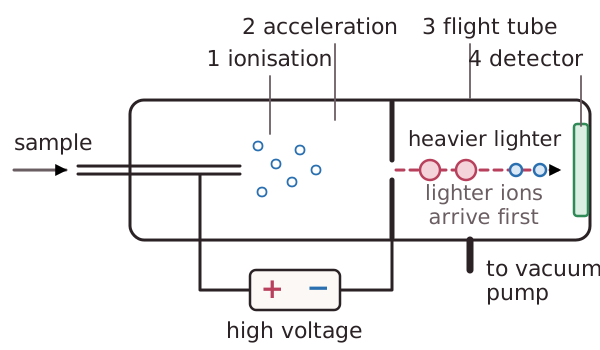 The time of flight depends on the mass of the isotope. The lighter ions travel faster and reach the detector sooner than the ions with more mass.The detector detects the ions as a pulse or current. The greater the abundance the larger the signal.The mass-to-charge or m/z ratio of all the signals is output as a mass spectrum.
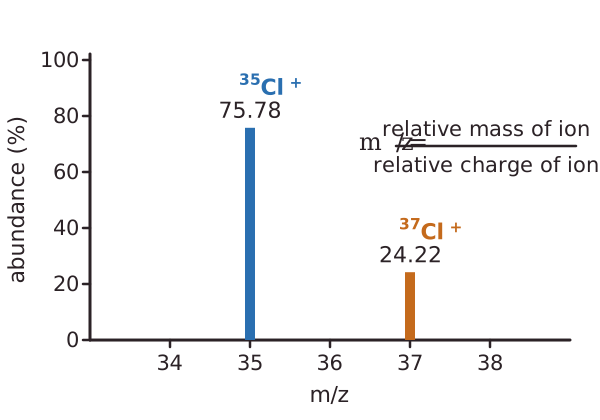 Ionisation occurs by electro spray ionisation. The sample is dissolved in a volatile, polar solvent and forced through a fine hollow needle that is connected to the positive terminal of a high voltage supply causing each molecule to pick up a protonM (g) + H+(g) → MH+(g).Electrospray ionisation is used for larger molecules. Elements and molecules with a low Mr are ionised by electron impact: high-energy electrons from an electron gun knock an electron off each particle:X(g) → X+(g) + e-.This produces tiny positively charged droplets. The solvent evaporates in the vacuum until single ions with a positive charge are formed.Acceleration of the ions towards a negatively charged plate separates the ions by mass. The lighter ions travel faster.Ion drift of the ions through a hole in the negatively charged plate forms a narrow beam that travels through the flight tube.Detection and Data Analysis occurs when the positive ions pick up an electron from the detector and the flight times are analysed. A computer generates the mass spectrum.
The time of flight depends on the mass of the isotope. The lighter ions travel faster and reach the detector sooner than the ions with more mass.The detector detects the ions as a pulse or current. The greater the abundance the larger the signal.The mass-to-charge or m/z ratio of all the signals is output as a mass spectrum.Ionisation occurs by electro spray ionisation. The sample is dissolved in a volatile, polar solvent and forced through a fine hollow needle that is connected to the positive terminal of a high voltage supply causing each molecule to pick up a protonM (g) + H+(g) → MH+(g).Electrospray ionisation is used for larger molecules. Elements and molecules with a low Mr are ionised by electron impact: high-energy electrons from an electron gun knock an electron off each particle:X(g) → X+(g) + e-.This produces tiny positively charged droplets. The solvent evaporates in the vacuum until single ions with a positive charge are formed.Acceleration of the ions towards a negatively charged plate separates the ions by mass. The lighter ions travel faster.Ion drift of the ions through a hole in the negatively charged plate forms a narrow beam that travels through the flight tube.Detection and Data Analysis occurs when the positive ions pick up an electron from the detector and the flight times are analysed. A computer generates the mass spectrum.