 BRAINCAKE
Low Resolution Mass Spectrometry
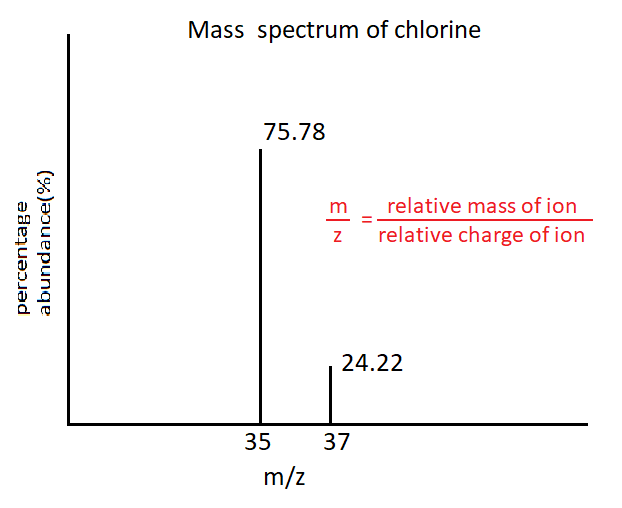
Low resolution mass spectrometryshows the m/z ratio or mass-to-charge ratio of each isotope and the corresponding percentage abundances.
Different isotopes are detected separately because they have different masses.
The relative heights of the peak gives the relative abundances and the m/z ration of a single charged ion gives the relative mass of the isotope.
Sign in free to see the rest of this lesson, the R.E.C.I.P.E. recall steps and the quiz
BrainCake is free. Make an account in seconds and pick up where this page stops.
Key terms in this lesson
- Isotopes
- Atoms of the same element with the same number of protons but different numbers of neutrons.
- Mass spectrometer
- An instrument used to measure the percentage abundances of isotopes in a sample of an element, from which relative atomic mass can be calculated.
More in Atomic Structure
- Electron Shells
- The Mass Spectrometer
- Time of Flight Mass Spectrometer
- Mass Spectra of Elements
- Mass Spectrometer in Space
- Quantum Mechanics
- Energy Levels
- Atomic Orbitals
All 22 lessons in Atomic Structure · All AQA AS-level Chemistry topics