 BRAINCAKE
Atomic Orbitals
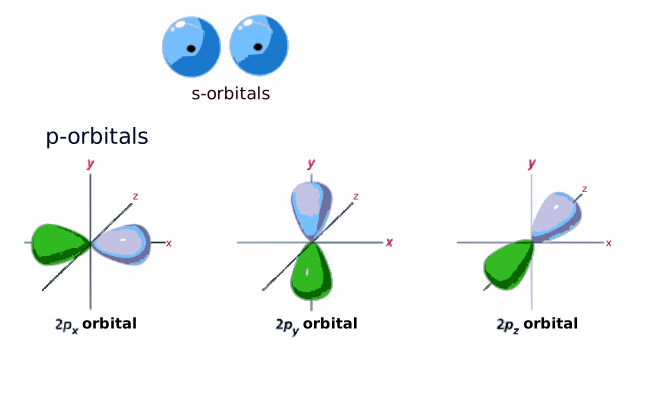
An electron is considered to be a cloud of negative charge that fills a volume in space called an atomic orbital.
Each orbital has a different energy level and a different shape that represents a region in space where there is a 95% probability of finding an electron.
Electrons are arranged within shells around the nucleus. The shells are regarded as energy levels. Each energy level has a principal quantum number n = 1, 2, 3, 4, 5, 6, 7 with the shell n = 1 with the lowest energy and closest to the nucleus.
Sign in free to see the rest of this lesson, the R.E.C.I.P.E. recall steps and the quiz
BrainCake is free. Make an account in seconds and pick up where this page stops.
Key terms in this lesson
- Principal quantum number
- The number (n = 1, 2, 3...) given to an electron shell, indicating its energy level and distance from the nucleus.
More in Atomic Structure
- Low Resolution Mass Spectrometry
- Mass Spectrometer in Space
- Quantum Mechanics
- Energy Levels
- Order of filling orbitals
- Electron Configuration
- First Ionisation Energy
- Successive Ionisation Energies
All 22 lessons in Atomic Structure · All AQA AS-level Chemistry topics