 BRAINCAKE
Reaction with Halogens
Alkenes react with halogens at room temperature by electrophilic addition. The two halogen atoms add to the two carbons of the C=C, giving a dihalogenoalkane with the halogens on adjacent carbons:
CH2=CH2 + Br2 → CH2BrCH2Br (1,2-dibromoethane)
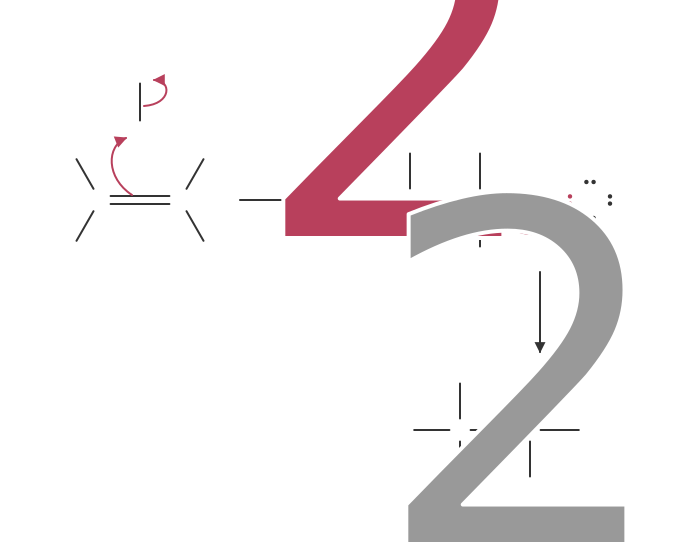
Br2 is a non-polar molecule, so how can it be an electrophile? As a Br2 molecule approaches the C=C, the high electron density of the double bond repels the electron pair in the Br–Br bond. This induces a dipole: the Br atom nearer the C=C gains a partial positive charge (δ+) and the further one becomes δ–.
Sign in free to see the rest of this lesson, the R.E.C.I.P.E. recall steps and the quiz
BrainCake is free. Make an account in seconds and pick up where this page stops.
Key terms in this lesson
- carbocation
- A positively charged carbon atom formed as a reactive intermediate when a bond breaks heterolytically.
- electrophile
- A species that accepts a pair of electrons to form a new covalent bond, attracted to regions of high electron density.
More in Alkenes
- Physical Properties of Alkenes
- Combustion
- Electrophiles
- Electrophilic Addition
- Reaction with Hydrogen Halides
- Asymmetrical Alkenes
- Reaction of Alkenes with Halogens
- Reaction with COncnetrated Sulfuric Acid
All 23 lessons in Alkenes · All AQA AS-level Chemistry topics