The typical reaction of alkenes is electrophilic addition. An electrophile attacks the C=C, the π bond breaks, and two atoms or groups add across the double bond. Two reactant molecules combine to form one product, which is saturated.The mechanism has two steps. Take a general electrophile Xδ+–Yδ–:Step 1: a curly arrow goes from the C=C bond to the δ+ atom X, and a second curly arrow goes from the X–Y bond to Y. The X–Y bond breaks heterolytically: both of its electrons go to Y, forming Y–. X is now bonded to one carbon, and the other carbon has lost its share of the π electrons, so it carries a positive charge. This intermediate is a carbocation.Step 2: a curly arrow goes from a lone pair on Y– to the positive carbon, forming a new bond.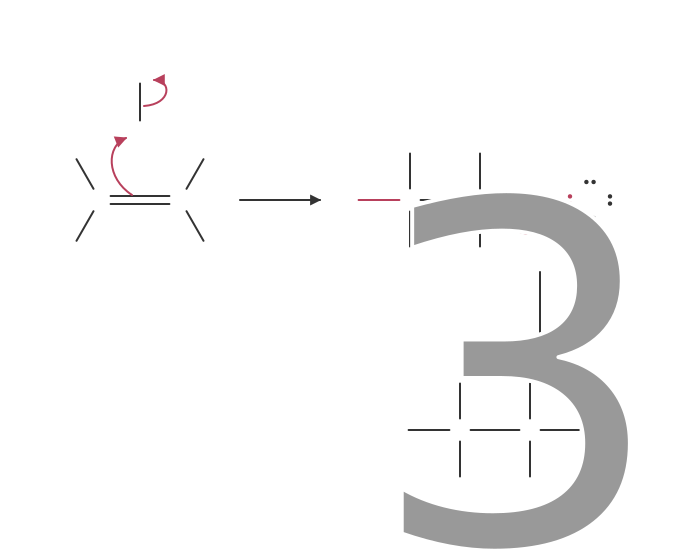
CH2=CH2 + HBr → CH3CH2Br The same two-step pattern applies to halogens and to sulfuric acid, which follow in the next lessons. When drawing it, show the partial charges on X–Y, the positive charge on the carbocation, and the lone pair and negative charge on Y–.