Alkanes are non-polar molecules because carbon and hydrogen have very similar electronegativities. The only forces between the molecules are weak van der Waals forces (induced dipole-dipole forces).Boiling point increases as the carbon chain gets longer. Longer molecules have more electrons and a larger surface area in contact, so the van der Waals forces are stronger and more energy is needed to separate the molecules.Branched alkanes have lower boiling points than their straight-chain isomers. Branches stop the molecules packing closely, so there is less surface contact and weaker van der Waals forces. Pentane boils at 36 °C but 2,2-dimethylpropane boils at 10 °C.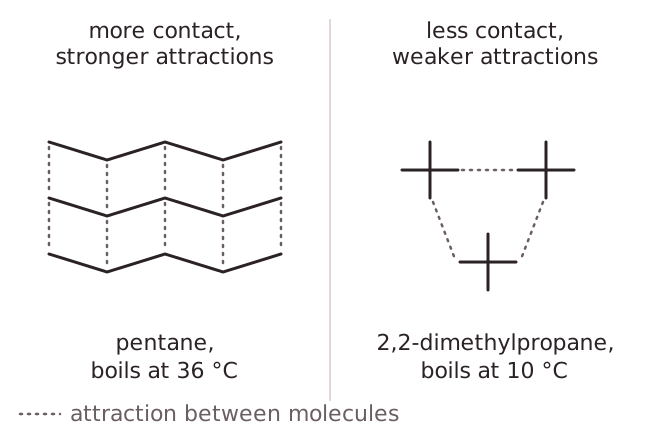 At room temperature the first four alkanes are gases, then liquids follow, and the larger alkanes are waxy solids.Alkanes are insoluble in water because they cannot form hydrogen bonds with water molecules. They are less dense than water, so they float on it.