Crude oil is a mixture consisting mainly of alkane hydrocarbons, with different chain lengths. It is separated into useful fractions by fractional distillation.The crude oil is heated until most of it vaporises and the vapour is passed into the bottom of a fractionating column. The column is hot at the bottom and cooler at the top, so there is a temperature gradient.The vapour rises up the column. Each hydrocarbon condenses when it reaches a level where the temperature is below its boiling point, and is collected on trays. Very large molecules do not vaporise and leave as a residue at the bottom.Short-chain hydrocarbons have low boiling points and are collected near the top, such as refinery gases and petrol. Longer chains are collected lower down, such as kerosene, diesel and fuel oil, and bitumen is the residue.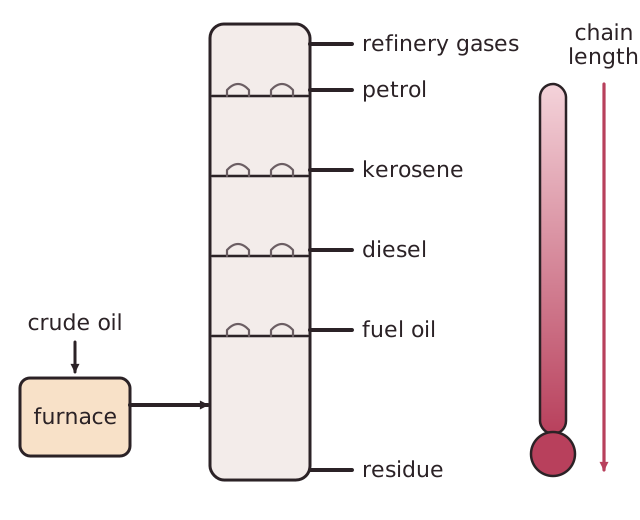 Each fraction is a mixture of hydrocarbons with similar chain lengths and boiling points, not a single compound.