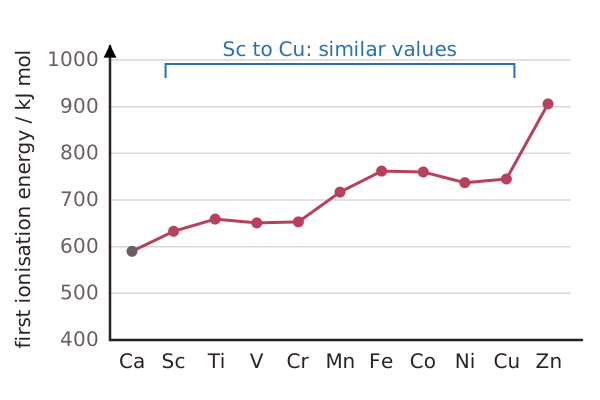
A transition metal is a metal that can form one or more stable ion with an incomplete d orbital.The first ionisation energies increase across a period due to the increase in nuclear charge without an increase in shielding electrons in inner orbitals. The effective nuclear charge across the d-block does not change as dramatically as in period 3 as although the actual nuclear charge increases, the number of shielding electrons in the 3d subshell increases as well. This means that the first ionisation energies of the elements in the d-block of period 4 are similar.There is a smaller difference between successive ionisation energies of transition metals.
Transition Metals
Read the text
Read the text and highlight anything you think is important. When you go on, the text is hidden and you answer from memory.
Specification: OCR Chemistry A (H432), A-level, 5.3.1 Transition elements. Topic: Transition Metals.
Key terms in this lesson
- first ionisation energy
- The enthalpy change when one electron is removed from each atom in one mole of gaseous atoms, forming one mole of gaseous 1+ ions, under standard conditions.
More in Transition Metals
- Properties of Transition Metals
- Complex Ions
- Shapes of complex ions
- Isomerism
- Formation of Coloured Ions
- Spectroscopy
- Ligand Substitution Reactions
- Vanadium
All 21 lessons in Transition Metals · All OCR A-level Chemistry topics