Ultraviolet light can break covalent bonds. When this happens free radicals are formed. The bond-breaking process is called homolytic fission. Each electron in the bond goes to a different atom.A free radical is an atom or group of atoms with an unpaired electron.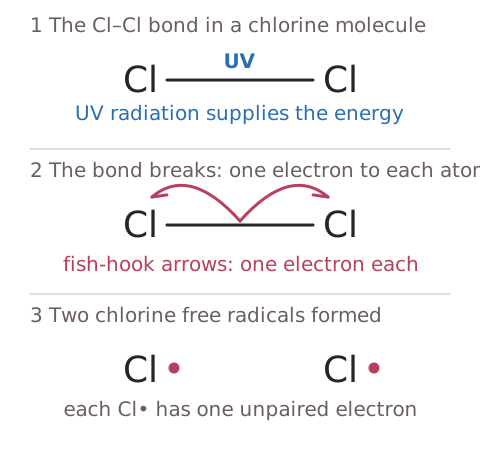 More fully, a radical is a reactive species consisting of an atom or group of atoms with an unpaired electron. The unpaired electron is shown as a dot, for example Cl• or •CH3.In homolytic fission, one electron of the bonding pair remains with each atom when a covalent bond is broken:
Cl2 → 2Cl• The energy for this comes from ultraviolet radiation. Non-polar bonds, such as the Cl-Cl bond, are the most likely to break this way.By contrast, in heterolytic fission both electrons of the bonding pair go to one atom, so ions are formed instead of radicals.Radicals are very reactive because the unpaired electron readily pairs up by forming a new bond. For example, a chlorine radical can remove a hydrogen atom from methane, forming HCl and a methyl radical:Cl• + CH4 → HCl + •CH3 The new radical can go on to react further, which is why radical reactions often continue as a chain.
More fully, a radical is a reactive species consisting of an atom or group of atoms with an unpaired electron. The unpaired electron is shown as a dot, for example Cl• or •CH3.In homolytic fission, one electron of the bonding pair remains with each atom when a covalent bond is broken: