Experiments are carried out to investigate the kinetics (rate of reaction) of three compounds A, B and C that react together.The results are shown in the table.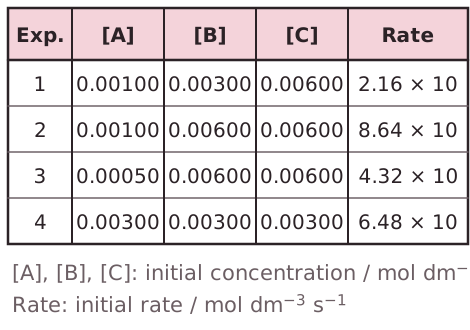 Comparing experiment 1 to experiment 2, [A] and [C] are constant. However, [B] doubles (×2) and the rate quadruples (×22), so the rate is second order with respect to B.Comparing experiments 2 with 3, [B] and [C] are constant but [A] has decreased by ×0.5 whilst the rate has decreased by ×0.5 . Therefore, the reaction is 1st order with respect to A.Comparing experiment 1 with 4, [B] is constant. Since A is first order and [A] has increased by ×3 as we would expect the rate increases by ×3. The ×0.5 decrease of [C] does not appear to have made a difference to the rate so the reaction is zero order with respect to C.The rate equation is given by:
rate = k [A] [B] 2 From experiment 1 k = 24.0 dm6mol-2s-1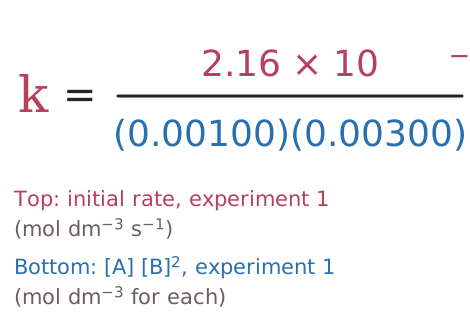
Comparing experiment 1 to experiment 2, [A] and [C] are constant. However, [B] doubles (×2) and the rate quadruples (×22), so the rate is second order with respect to B.Comparing experiments 2 with 3, [B] and [C] are constant but [A] has decreased by ×0.5 whilst the rate has decreased by ×0.5 . Therefore, the reaction is 1st order with respect to A.Comparing experiment 1 with 4, [B] is constant. Since A is first order and [A] has increased by ×3 as we would expect the rate increases by ×3. The ×0.5 decrease of [C] does not appear to have made a difference to the rate so the reaction is zero order with respect to C.The rate equation is given by: