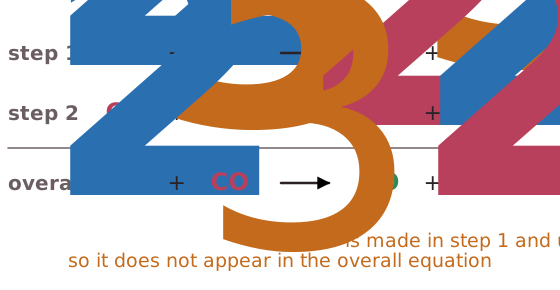
Chemical reactions often take place in a series of steps called the reaction mechanism. In a multi-step reaction, the slowest step is called the rate-determining step. The reaction cannot go faster than the rate-determining step. If the concentration of a reactant appears in the rate equation, then the reactant or something derived from it takes part in the slow step of the reaction. Nitrogen dioxide reacts with carbon monoxide to form nitrogen monoxide and carbon dioxide. NO2 + CO → NO + CO2 The result of rate experiments gives the rate equation: rate = k[NO2]2 This means that two molecules of NO2 are involved in the rate-determining (slow) step. NO3 is an intermediate as it does not appear in the overall equation.Intermediates are usually short-lived.
The Rate Determining Step
Read the text
Read the text and highlight anything you think is important. When you go on, the text is hidden and you answer from memory.
Specification: OCR Chemistry A (H432), A-level, 5.1.1 How fast?. Topic: Rate of Reaction.
Key terms in this lesson
- rate equation
- An equation that shows how the rate of a reaction depends on the concentration of each reactant, each raised to a power called its order.
More in Rate of Reaction
- Experimental Determination of the Rate of Reaction
- The Rate Equation
- The Order of a Reaction
- The Rate Constant k
- Worked Example
- Half-Lives and Reaction Rate Graphs
- Catalysts
- The Effect of Temperature and Catalysts on the Rate Constant.
All 11 lessons in Rate of Reaction · All OCR A-level Chemistry topics