The position of each spot on a TLC plate is described by its Rf value (retention factor):Rf = distance moved by component ÷ distance moved by solvent front Both distances are measured from the baseline: to the centre of the spot, and to the solvent front line.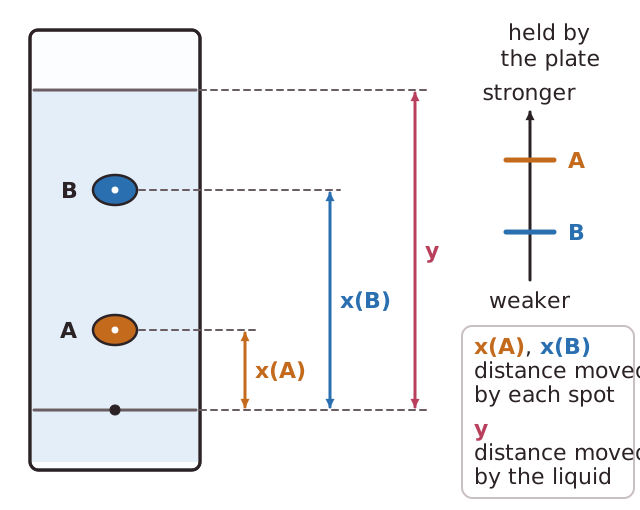 Because the component can never travel further than the solvent, Rf is always between 0 and 1 and has no units. A component that is strongly adsorbed onto the stationary phase has a small Rf; one that is weakly adsorbed has an Rf close to 1.Worked example: the solvent front is 8.0 cm from the baseline. Spot A is 2.4 cm from the baseline and spot B is 6.0 cm.
Rf(A) = 2.4 ÷ 8.0 = 0.30
Rf(B) = 6.0 ÷ 8.0 = 0.75
A is more strongly adsorbed than B.Rf values can be compared with known values in a database to suggest the identity of a component. However, an Rf value is only characteristic for the same stationary phase, the same solvent and the same temperature, so a reference sample is often run on the same plate.Two different compounds can have very similar Rf values in one solvent, so a match does not prove identity. Running the plate again in a different solvent helps separate compounds with similar Rf values.
Because the component can never travel further than the solvent, Rf is always between 0 and 1 and has no units. A component that is strongly adsorbed onto the stationary phase has a small Rf; one that is weakly adsorbed has an Rf close to 1.Worked example: the solvent front is 8.0 cm from the baseline. Spot A is 2.4 cm from the baseline and spot B is 6.0 cm.Rf(A) = 2.4 ÷ 8.0 = 0.30
Rf(B) = 6.0 ÷ 8.0 = 0.75
A is more strongly adsorbed than B.Rf values can be compared with known values in a database to suggest the identity of a component. However, an Rf value is only characteristic for the same stationary phase, the same solvent and the same temperature, so a reference sample is often run on the same plate.Two different compounds can have very similar Rf values in one solvent, so a match does not prove identity. Running the plate again in a different solvent helps separate compounds with similar Rf values.