Gas chromatography (GC) separates volatile components of a mixture, and is sensitive enough to detect very small amounts.• The mobile phase is an unreactive carrier gas, such as helium or nitrogen.
• The stationary phase is a high-boiling liquid coated on an inert solid support (or on the inside wall) inside a long, thin, coiled capillary column.
• The column is kept inside an oven so the sample stays as a gas.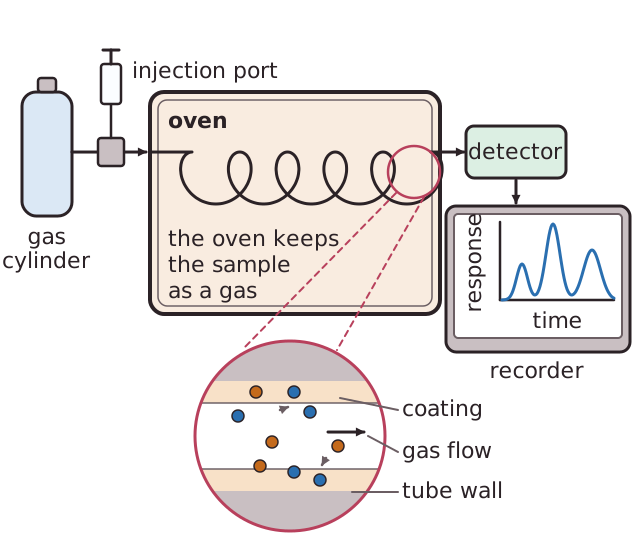 A small sample is injected, vaporises and is carried through the column by the carrier gas. Components separate by their relative solubility in the liquid stationary phase: a component that is more soluble in the liquid spends longer dissolved in it and moves through the column more slowly.A detector at the end of the column records when each component comes out. The output is a gas chromatogram: a graph of detector response against time, with one peak for each separated component.Boiling point matters too: a more volatile component spends more time in the gas phase, so it tends to leave the column sooner.Worked example: a mixture of two esters gives two peaks. The ester that is more soluble in the stationary phase is the one whose peak appears later.GC is often linked to a mass spectrometer (GC-MS). Each separated component is identified from its mass spectrum; this is used in forensics, airport security and testing for drugs in sport.
• The stationary phase is a high-boiling liquid coated on an inert solid support (or on the inside wall) inside a long, thin, coiled capillary column.
• The column is kept inside an oven so the sample stays as a gas.
A small sample is injected, vaporises and is carried through the column by the carrier gas. Components separate by their relative solubility in the liquid stationary phase: a component that is more soluble in the liquid spends longer dissolved in it and moves through the column more slowly.A detector at the end of the column records when each component comes out. The output is a gas chromatogram: a graph of detector response against time, with one peak for each separated component.Boiling point matters too: a more volatile component spends more time in the gas phase, so it tends to leave the column sooner.Worked example: a mixture of two esters gives two peaks. The ester that is more soluble in the stationary phase is the one whose peak appears later.GC is often linked to a mass spectrometer (GC-MS). Each separated component is identified from its mass spectrum; this is used in forensics, airport security and testing for drugs in sport.