A gas chromatogram gives two kinds of information.Retention time is the time from injecting the sample to the component reaching the detector. Under the same conditions (same column, temperature and carrier gas flow rate), a compound always has the same retention time, so it can be identified by comparing it with known retention times.Peak area is proportional to the amount of that component. Comparing peak areas gives the proportions of the components in the mixture:percentage of component = (its peak area ÷ total peak area) × 100 Worked example: a mixture gives three peaks with areas 20, 50 and 30 units.
Total area = 100.
The second component is (50 ÷ 100) × 100 = 50% of the mixture.To find an actual concentration, an external calibration curve is used:1. Run standard solutions of the compound of known concentrations under the same conditions.
2. Plot peak area against concentration. This gives a straight line through the origin.
3. Run the unknown sample, measure its peak area and read its concentration from the graph.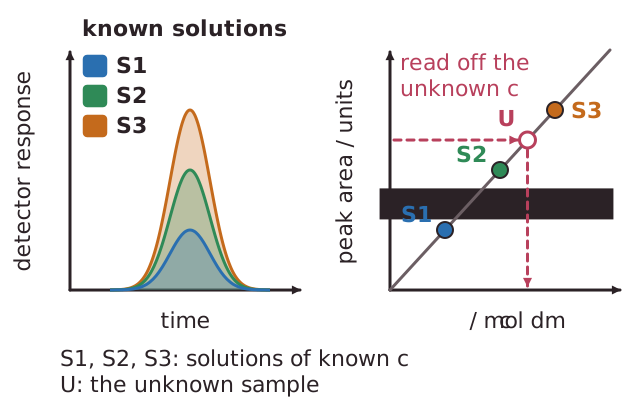 Worked example: standards show that a peak area of 40 units corresponds to 0.10 mol dm−3. An unknown with a peak area of 60 units has a concentration of (60 ÷ 40) × 0.10 = 0.15 mol dm−3.
Total area = 100.
The second component is (50 ÷ 100) × 100 = 50% of the mixture.To find an actual concentration, an external calibration curve is used:1. Run standard solutions of the compound of known concentrations under the same conditions.
2. Plot peak area against concentration. This gives a straight line through the origin.
3. Run the unknown sample, measure its peak area and read its concentration from the graph.
Worked example: standards show that a peak area of 40 units corresponds to 0.10 mol dm−3. An unknown with a peak area of 60 units has a concentration of (60 ÷ 40) × 0.10 = 0.15 mol dm−3.