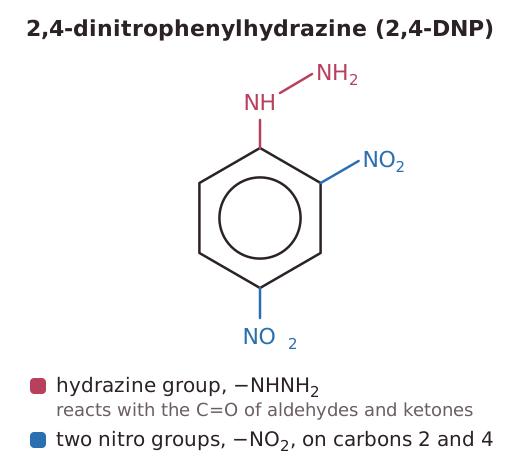
Once a carbonyl compound has been identified as an aldehyde or ketone, further tests can be carried out to identify the compound. Both aldehydes and ketones can be detected using 2,4-DNP - 2,4-dinitrophenylhydrazine in a mixture of methanol and sulfuric acid. This is known as Brady's reagent.When Brady's reagent is added to an aldehyde or ketone a yellow or orange precipitate of a 2,4-dinitrophenylhydrazone derivative forms. There is no precipitate formed with an ester or carboxylic acid. The impure product can be filtered and recrystallised to produce a pure sample. This can be filtered and dried and the melting point can be determined and compared to a database to identify the original aldehyde or ketone.