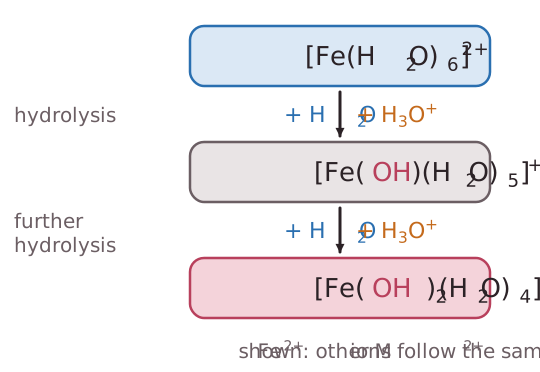
Transition metal 2+ ions form octahedral hexaaqua II complexes with water. Transition metal 3+ ions form hexaaqua 3+ ions in water. In both cases water forms six co-ordinate bonds with the central metal ion. Hexaaqua complexes are slightly acidic in water due to their dissociation of water molecules to release H+ ions.Due to the increased charge density of the Fe3+ ion, it is able to polarise the water molecule more thus dissociating it more easily. Transition metal 3+ ions form more acidic solutions than 2+ ions. They are smaller and have a higher charge therefore are more polarising.Further hydrolysis occurs until a precipitate is formed.