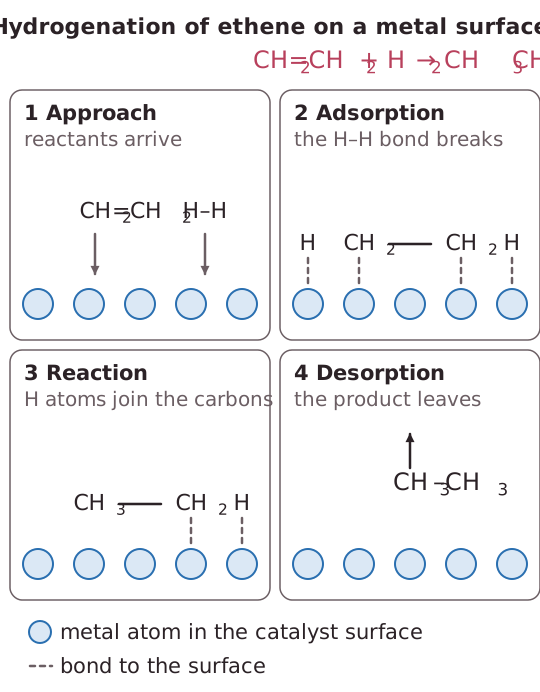
A heterogeneous catalyst is one that is in a different phase from the reactants. Transition metals make good catalysts because they can change their oxidation states by gaining or losing electrons within their d orbitals and transfer electrons to speed up reactions.Increasing the surface area increases the number of molecules that can adsorb to the surface of a heterogeneous catalyst. Catalyst poisoning may occur where impurities adhere to the surface of the catalyst and can be reduced by purifying the reactants.Transition metals have partly full d orbitals which can be used to form weak chemical bonds with the reactants.