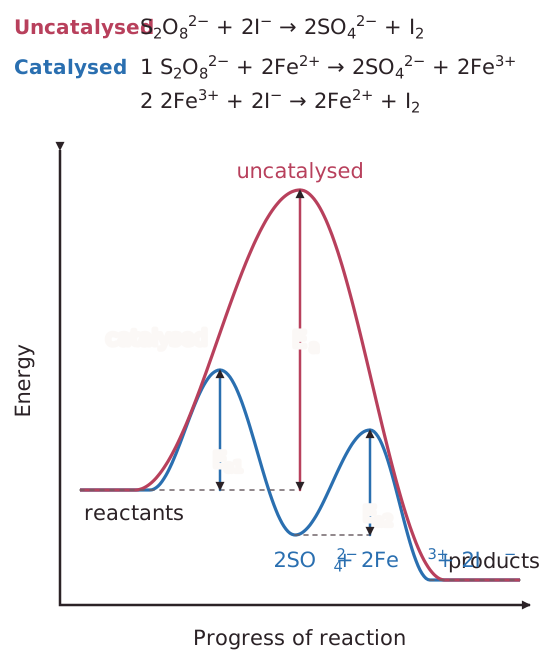
Homogeneous catalysts are in the same physical state as the reactants. During the course of the reaction an intermediate species is formed. The intermediate then reacts to form the final product.An example is the catalysis of the oxidation of I- iodide ions by peroxodisulfate ions S2O82- by Fe2+ ions. The uncatalysed reaction is slow because both ions are negative and so repel each other giving a high activation energy. However, both steps of the catalysed reaction involve oppositely charged ions which partly explains increased rate of reaction. First the peroxodisulfate ions oxidise Fe2+ ions to Fe3+ ions. Then the Fe3+ions oxidise I- to I2. The overall activation energy for both steps of the reaction is lower than the activation energy for the uncatalysed reaction.