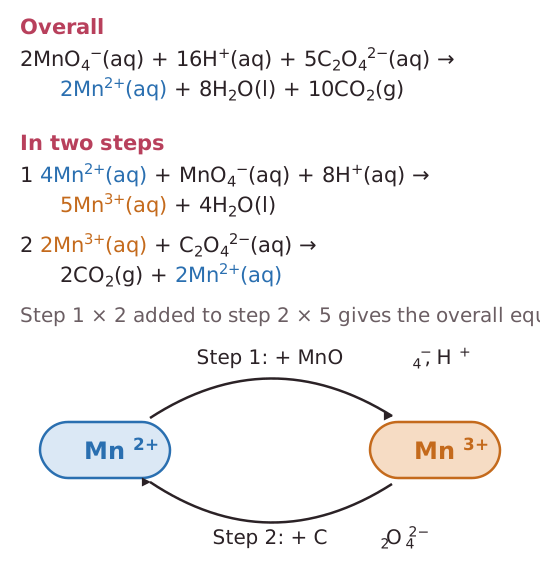
This occurs when one of the products of a reaction is also a catalyst for the reaction. Initially, the reaction proceeds slowly at the uncatalysed rate. As more and more catalyst is formed the reaction speeds up to the catalysed rate then proceeds like a normal catalysed reaction. Eventually, the reaction slows down as the reactants are used up.An example is the reaction between ethanedioic acid and an acidified solution of potassium manganate VII. The catalyst Mn2+ is formed and reacts with MnO4- ions to form an intermediate species Mn3+. The Mn3+ then reacts with the C2O42- ions to regenerate the Mn2+ ions.