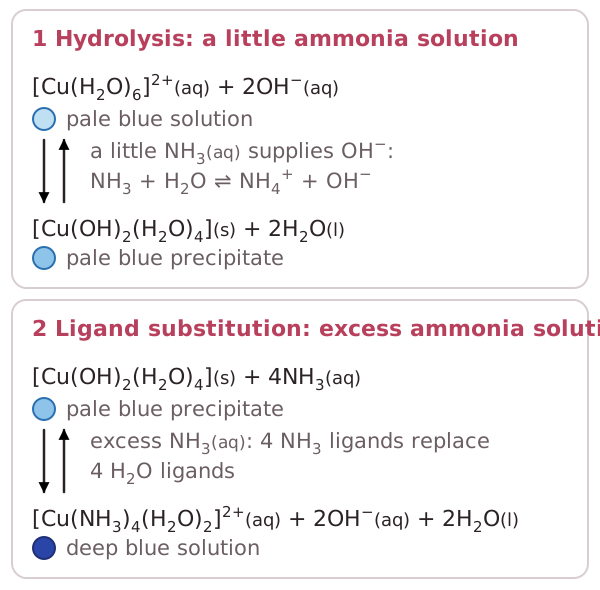
Ammonia can act as both a ligand and a base. In dilute ammonia solution, ammonia acts as a source of OH- ions and transition metal ions react to form coloured precipitates as hydrolysis reactions occur. When an excess of ammonia is added ligand substitution takes place.If a small amount of dilute ammonia solution is added to a solution of hexaaquacopper (II) ions, a pale blue precipitate forms. On addition of excess aqueous ammonia the pale blue precipitate dissolves and the solution changes to a deep blue solution as four of the water ligands are replaced by four ammonia ligands. The product is a distorted octahedral complex as the copper-oxygen bonds are longer than the copper-nitrogen bonds. On addition of excess ammonia the Fe2+ and Fe3+ precipitates formed do not dissolve.