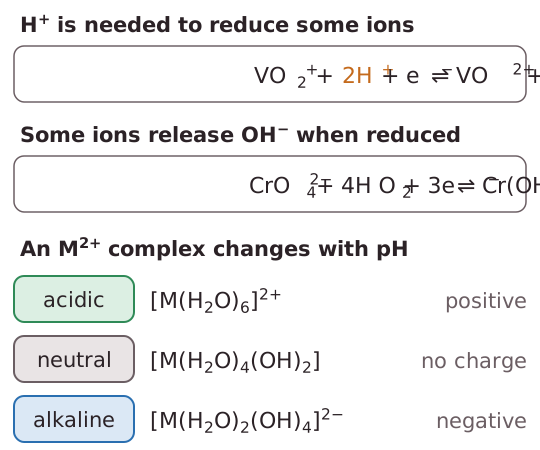
The redox potential of a transition metal is a measure of how easily it can be reduced to a lower oxidation state. The more positive the redox potential the more easily the reduction as the ion will be less stable. Metal ions in high oxidation states are only reduced in the presence of H+ ions so the redox potential is affected by pH. Usually, the more acidic the solution, the more positive the redox potential. Some ions release OH- when they are reduced. Oxidation of metal ions in lower oxidation states tends to happen in alkaline solution as there is a tendency to form negative ions and oxidation is loss of electrons.Different ligands bind more/less strongly to ions in different oxidation states which may make the ion more difficult/easier to reduce so ligands also affect the redox potential.